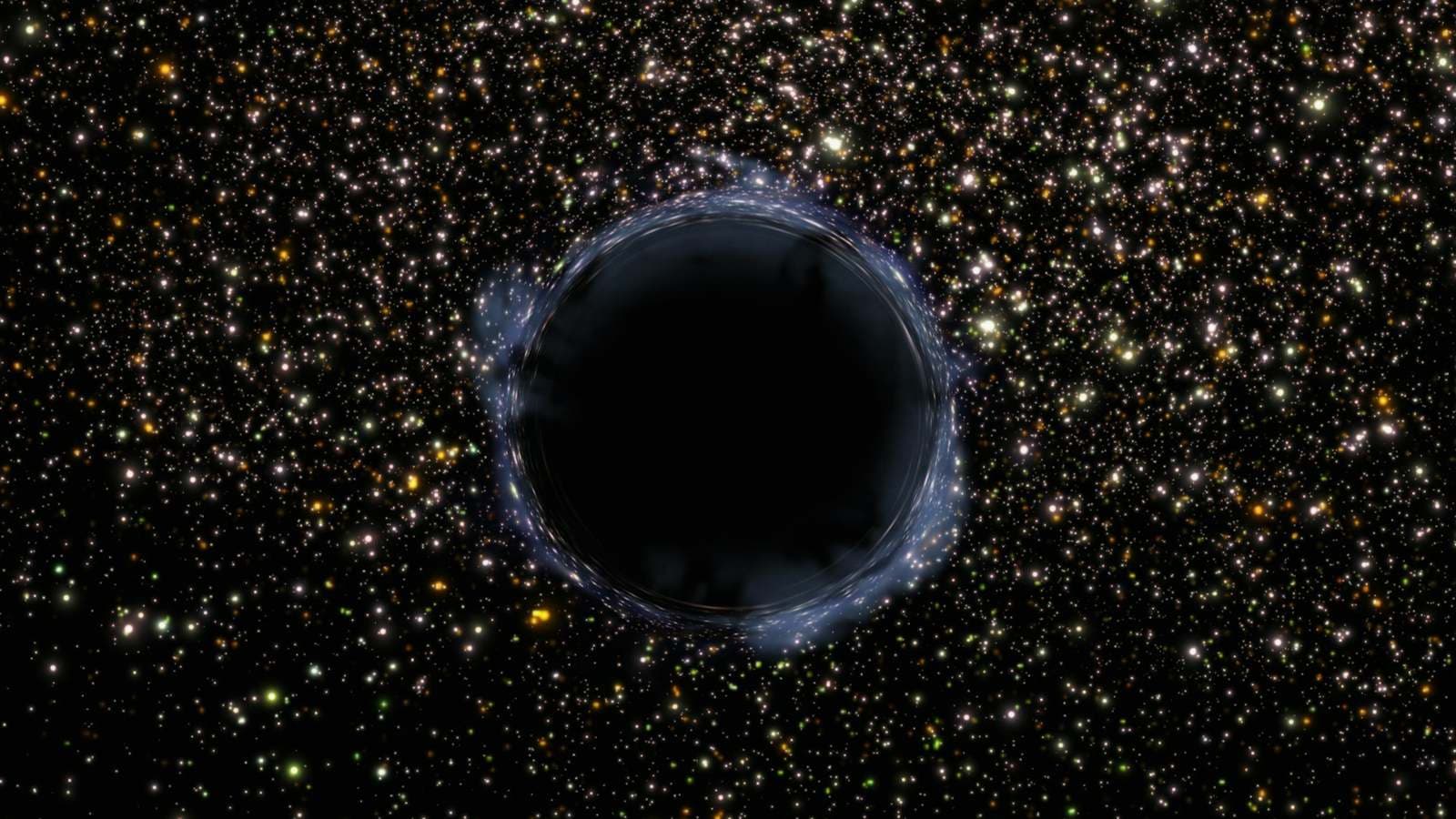

Black holes are among the most fascinating and mysterious phenomena in the cosmos. For decades, sci-fi movies and pop culture have depicted them as giant, cosmic vacuum cleaners floating through space, devouring everything in their path.
While science fiction gets some parts right, the scientific reality of black holes is even stranger. Here are 5 mind-blowing facts about black holes explained in simple terms that will change the way you look at the universe.
1. Time Literally Slows Down Near a Black Hole
According to Albert Einstein’s theory of General Relativity, massive objects warp the fabric of space and time (known as spacetime). Because a black hole concentrates immense mass into an infinitely small point, its gravitational pull is extreme.
The closer you get to a black hole, the stronger its gravity becomes, causing time to tick slower for you compared to someone far away.
-
Simple Analogy: If you watched an astronaut fall toward a black hole from a safe distance, you would see their movement slow down as they approached the boundary. To an outside observer, they would appear frozen in time forever right at the edge.
2. Falling Into a Black Hole Stretches You Like Spaghetti
If an astronaut fell into a stellar black hole feet-first, they would experience a gruesome astrophysics phenomenon known formally as Spaghettification (or the noodle effect).
Because gravitational pull decreases with distance, the gravity acting on your feet would be exponentially stronger than the gravity acting on your head.
-
What Happens: This massive difference in pull stretches your body vertically and compresses it horizontally, turning you into a long, thin string of matter before you even reach the center.
3. Black Holes Do Not "Suck Up" Everything in Space
A common misconception is that black holes act like giant cosmic vacuum cleaners, pulling in stars and planets from light-years away. In reality, black holes obey the same laws of gravity as any other massive celestial body.
Gravity depends on mass and distance—not whether an object is a star or a black hole.
-
Fun Fact: If our Sun were instantly replaced by a black hole with the exact same mass, Earth would not be sucked in. Instead, Earth would continue orbiting the black hole on the exact same path—though it would quickly become very cold and dark!
4. Black Holes Can Slowly Shrink and Die
For a long time, scientists believed that once matter entered a black hole, it was trapped forever and the black hole would only grow larger. However, in 1974, famous physicist Stephen Hawking proposed a revolutionary theory known as Hawking Radiation.
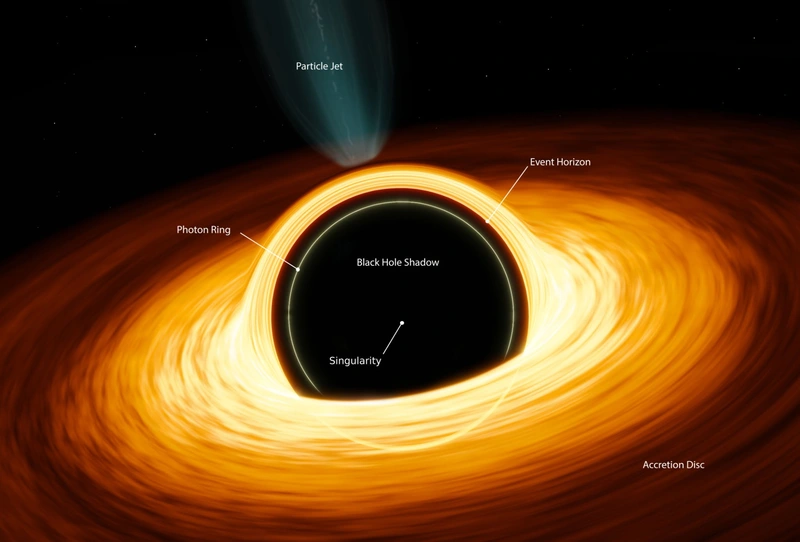
Due to quantum physics effects occurring near the outer boundary (the Event Horizon), black holes constantly emit tiny amounts of thermal radiation.
-
The Result: Over astronomical time scales, black holes slowly lose mass. If a black hole does not consume new matter to replenish its mass, it will eventually evaporate completely and disappear in a final burst of energy.
5. There Is a Supermassive Black Hole at the Center of Our Galaxy
Black holes are not just rare, isolated cosmic anomalies floating in deep space. In fact, scientists have confirmed that almost every major galaxy has a Supermassive Black Hole sitting right at its core.
Our home galaxy, the Milky Way, houses a giant black hole named Sagittarius A* (pronounced Sagittarius A-star).
-
Key Stats:
-
Mass: Roughly 4 million times the mass of our Sun.
-
Distance: Located approximately 26,000 light-years away from Earth.
-
Status: Don't worry—it is far enough away that Earth is completely safe in its stable galactic orbit!
-
Summary Table: Black Hole Concepts at a Glance
| Scientific Term | Simple Meaning |
| Event Horizon | The "point of no return" boundary where light cannot escape. |
| Singularity | The center point of a black hole where matter is crushed into infinite density. |
| Spaghettification | The physical stretching of matter caused by extreme differences in gravity. |
| Hawking Radiation | Energy released by a black hole that causes it to slowly evaporate over time. |
Final Thoughts
Black holes challenge our understanding of physics, gravity, and the universe itself. From bending time to evaporating over billions of years, these cosmic structures prove that real space science is often stranger than fiction.
Frequently asked questions
Can a black hole destroy the entire universe?+
No. While black holes have extremely strong gravitational pulls, their influence is limited by distance. Objects must get very close to a black hole's event horizon to be pulled in. Outside of that boundary, gravity behaves normally.
What is the point of no return for a black hole?+
The point of no return is called the Event Horizon. It is the outer boundary surrounding a black hole where the escape velocity exceeds the speed of light. Once anything—including light—crosses this boundary, it cannot escape.
What is the closest black hole to Earth?+
The closest known black hole to Earth is Gaia BH1, located approximately 1,560 light-years away in the constellation Ophiuchus. It poses zero threat to our solar system.