
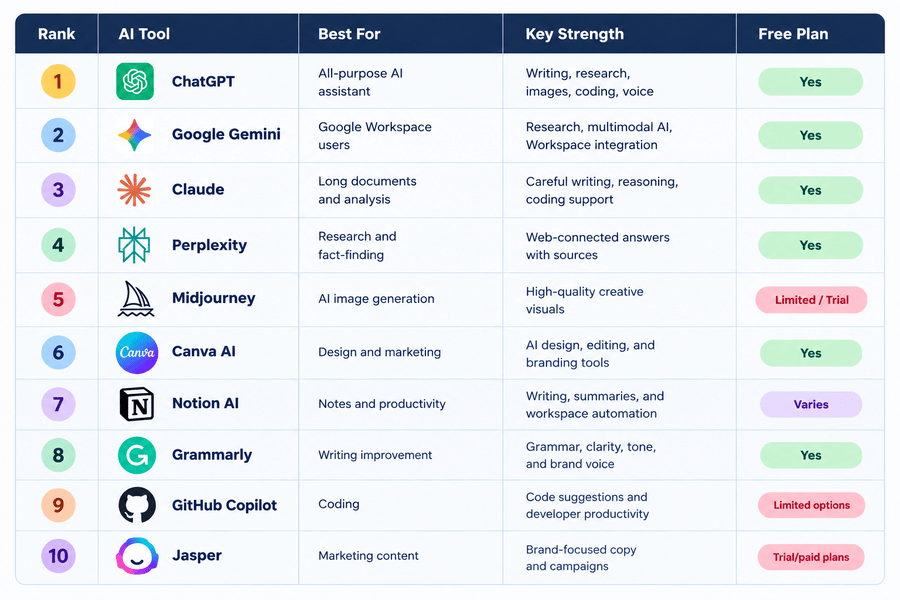
The top 10 AI tools in 2026 are ChatGPT, Gemini, Claude, Perplexity, Midjourney, Canva AI, Notion AI, Grammarly, GitHub Copilot, and Jasper. These AI tools help us to write content, research faster, create images, automate tasks, improve SEO, and build software more efficiently.
AI tools now support to research, content optimization, technical audits, and brand visibility across AI-powered search platforms. The best choice depends on your goal: general productivity, content creation, coding, visual design, or SEO.
Quick Comparison: Top 10 AI Tools
1. ChatGPT
ChatGPT is the best all-purpose AI tool in 2026. It supports writing, brainstorming, coding, image generation, voice interaction, research, and automation, making it suitable for students, marketers, developers, and business owners.
ChatGPT is especially useful when you need one tool for many tasks. You can use it to create blog outlines, write emails, summarize documents, generate code, analyze data, and produce social media content.
Best for: General users, marketers, students, entrepreneurs, and developers.
2. Google Gemini
Google Gemini is one of the best AI tools for users already working in Google Workspace. It integrates with tools such as Gmail, Docs, Sheets, and Drive, helping users draft emails, analyze spreadsheets, summarize files, and research information.
Gemini is strong for multimodal tasks because it can work with text, images, and other inputs. It is a good option for businesses that already rely on Google’s ecosystem.
Best for: Research, Google Workspace users, teams, and multimodal work.
3. Claude
Claude is a top AI tool for long-form writing, analysis, and coding. Anthropic’s assistant is known for careful, structured writing and strong performance with long documents and complex reasoning tasks.
Claude is useful for drafting reports, reviewing contracts or research papers, creating detailed content, and supporting development work. Its Connectors and Skills also allow users to customize how it works
Best for: Writers, analysts, developers, and professionals handling long documents.
4. Perplexity
Perplexity is one of the best AI search engines for research. Unlike a standard chatbot, it focuses on providing web-connected answers with citations, making it useful for fact-checking, competitor research, and current-information queries.
For SEO teams, Perplexity can help identify questions people ask, summarize search results, and research topics before creating content. AI search tools increasingly reward clear, factual, question-focused content.
Best for: Research, fact-checking, students, journalists, and SEO professionals.
5. Midjourney
Midjourney is one of the best AI image generators for creative and visual work. It is widely used for concept art, advertising visuals, product mockups, social media graphics, and brand imagery.
Midjourney is ideal when visual quality matters more than simple quick edits. Marketers can use it to create original visuals, while designers can use it to explore creative directions before final production.
Best for: Designers, creators, advertisers, and social media teams.
6. Canva AI
Canva AI is the best AI design tool for non-designers. Its Magic Studio features include Magic Write for text, Magic Design for layouts, and Magic Edit for modifying images using natural-language instructions.
Canva is especially useful for small businesses, social media managers, and content creators who need professional visuals without advanced design software.
Best for: Social media graphics, presentations, ads, and branding.
7. Notion AI
Notion AI is a leading AI productivity tool for notes, documentation, and team knowledge. It can summarize meeting notes, draft documents, answer questions from workspace content, and help teams organize information.
It is particularly valuable for startups and remote teams that need one connected workspace for projects, documents, wikis, and internal communication.
Best for: Teams, project management, documentation, and knowledge bases.
8. Grammarly
Grammarly is one of the best AI writing assistants for improving clarity, grammar, and tone. It helps users correct spelling and grammar mistakes, improve sentence structure, adjust formality, and maintain a consistent brand voice.
Grammarly is useful for emails, reports, blog posts, resumes, and customer communication. It works best as an editing layer alongside an AI writing tool such as ChatGPT or Claude.
Best for: Professionals, students, writers, and business communication.
9. GitHub Copilot
GitHub Copilot is one of the best AI coding tools for developers. It helps programmers write code faster, understand unfamiliar code, fix errors, and generate functions directly inside their development environment.
For development teams, Copilot can reduce repetitive coding work and speed up prototyping. However, developers should still review generated code for security, performance, and correctness.
Best for: Developers, software teams, and technical projects.
10. Jasper
Jasper is a strong AI tool for marketing teams that need brand-consistent content at scale. It helps create blog posts, ads, emails, landing pages, and social content while maintaining a defined brand voice.
Jasper is best for businesses that produce a high volume of marketing material. It can also work alongside SEO tools to optimize content for target keywords and search intent
Best for: Marketing teams, agencies, and content operations.
How to Choose the Best AI Tool
Choose an AI tool based on your main goal rather than trying to use every platform.
-
For one flexible AI assistant: Choose ChatGPT.
-
For Google Workspace work: Choose Gemini.
-
For long documents and careful writing: Choose Claude.
-
For research with sources: Choose Perplexity.
-
For AI images: Choose Midjourney.
-
For easy design: Choose Canva AI.
-
For team documentation: Choose Notion AI.
-
For editing and tone: Choose Grammarly.
-
For coding: Choose GitHub Copilot.
-
For marketing content: Choose Jasper.
Many users combine tools: for example, research with Perplexity, draft with ChatGPT or Claude, edit with Grammarly, and create visuals with Canva AI. This workflow improves both quality and productivity.
Are AI Tools Worth It?
Yes. AI tools are worth it when they save time on repetitive work, improve output quality, or help you create content faster. For businesses, they can support keyword research, content optimization, technical SEO, and visibility in AI-driven search experiences
However, AI should assist—not replace—human judgment. Always review facts, edit for brand voice, verify sources, and avoid publishing unedited AI content.
Frequently asked questions
What are the top 10 AI tools in 2026?+
The top 10 AI tools are ChatGPT, Google Gemini, Claude, Perplexity, Midjourney, Canva AI, Notion AI, Grammarly, GitHub Copilot, and Jasper.
Which AI tool is best for beginners?+
ChatGPT and Canva AI are best for beginners. ChatGPT is easy for writing and research, while Canva AI is simple for creating social media posts, presentations, and marketing designs.
Which AI tool is best for SEO?+
For SEO, use a combination of ChatGPT or Claude for content drafting, Perplexity for research, and dedicated SEO platforms for keyword data, audits, and optimization. AI SEO tools commonly support keyword research, content optimization, rank tracking, and technical audits.
Which AI tool is best for content writing?+
Claude and ChatGPT are excellent for long-form content, while Jasper is better for marketing teams that need consistent brand messaging. Grammarly is useful for final editing and tone improvement.
Are there free AI tools?+
Yes. ChatGPT, Gemini, Claude, Perplexity, Canva AI, and Grammarly offer free or limited free access, though paid plans usually provide higher usage limits and advanced features.
What is the best AI tool for business?+
ChatGPT is the best overall business AI tool because it supports communication, research, planning, content creation, and automation. Teams using Google Workspace may prefer Gemini, while marketing teams may prefer Jasper.